
The Laws of Motion were formulated by Sir Isaac Newton to describe the relationship between force and motion. These laws apply to objects moving at ordinary speeds and sizes and are valid in everyday situations.
There are three laws of motion. Each law explains a different aspect of motion, but all three laws work together and cannot be treated in isolation.
Table of Contents
Newton’s First Law of Motion
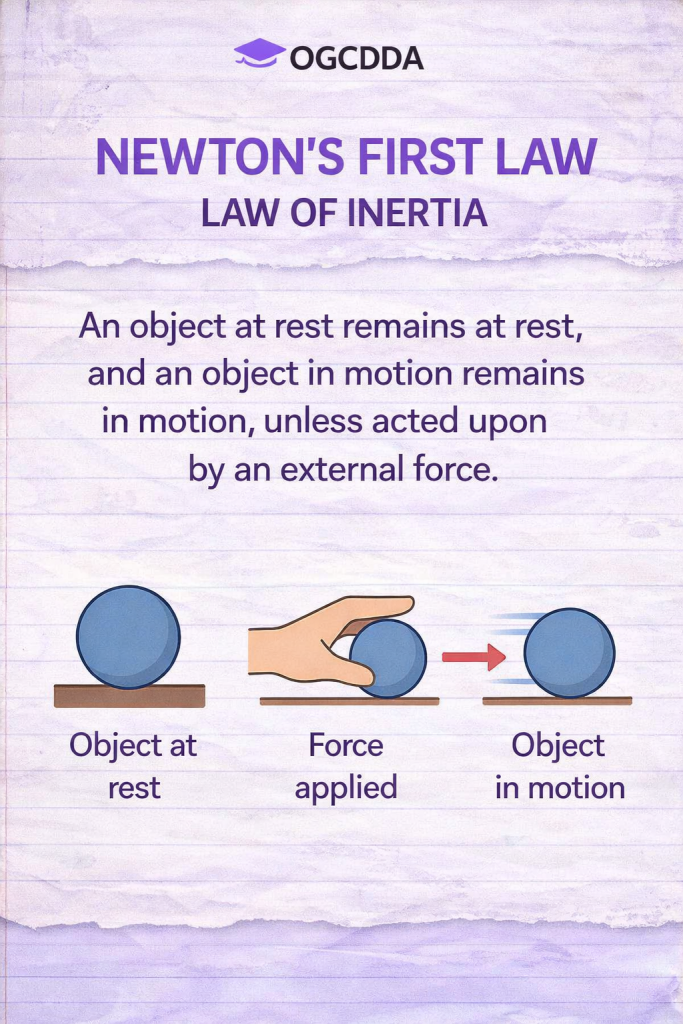
Newton’s First Law of Motion states that an object remains at rest or continues to move with uniform velocity in a straight line unless acted upon by an external unbalanced force.
This law explains the natural tendency of objects to maintain their current state of motion. If an object is at rest, it will remain at rest. If it is moving with constant velocity, it will continue moving in the same way unless a force changes that state.
The First Law is also known as the law of inertia because it introduces the concept of inertia.
Inertia
Inertia is the property of a body by which it resists any change in its state of rest or uniform motion. Every object has inertia, and greater the mass of the object, greater is its inertia.
A heavy object is harder to start moving and harder to stop once it is moving. A light object can be started or stopped more easily. This difference is due to inertia.
In exams, inertia is always associated with mass, not with speed or force.
Types of Inertia
Inertia of Rest
Inertia of rest is the tendency of a body at rest to remain at rest. An object does not start moving on its own unless a force acts on it.
For example, a book lying on a table remains at rest until someone applies a force to move it.
This type of inertia explains why passengers fall backward when a stationary bus suddenly starts moving.
Inertia of Motion
Inertia of motion is the tendency of a moving body to continue moving with the same velocity unless acted upon by a force.
For example, a rolling ball continues to move until friction slows it down.
This type of inertia explains why passengers fall forward when a moving bus suddenly stops.
Inertia of Direction
Inertia of direction is the tendency of a body to continue moving in the same direction.
For example, when a car takes a sharp turn, passengers tend to lean sideways due to inertia of direction.
In exams, questions involving sudden turns usually test inertia of direction.
Newton’s First Law and Force
Newton’s First Law clearly states that force is not required to maintain motion. Force is required only to change motion.
This law removes the misconception that continuous force is needed to keep an object moving. In the absence of external forces, an object moves with uniform velocity.
In exam questions, statements like “force is required to keep an object moving” are incorrect.
Newton’s Second Law of Motion
Newton’s Second Law of Motion states that the rate of change of momentum of a body is directly proportional to the applied force and takes place in the direction of the force.
This law gives a quantitative relationship between force and motion.
It explains not only that force changes motion, but also how much motion changes for a given force.
Momentum
Momentum is defined as the product of mass and velocity of a body.
p = mv
Momentum is a vector quantity because velocity has direction.
A heavier object or a faster-moving object has greater momentum.
Statement of Second Law in Mathematical Form
According to Newton’s Second Law:
F ∝ dp / dt
For constant mass, this becomes:
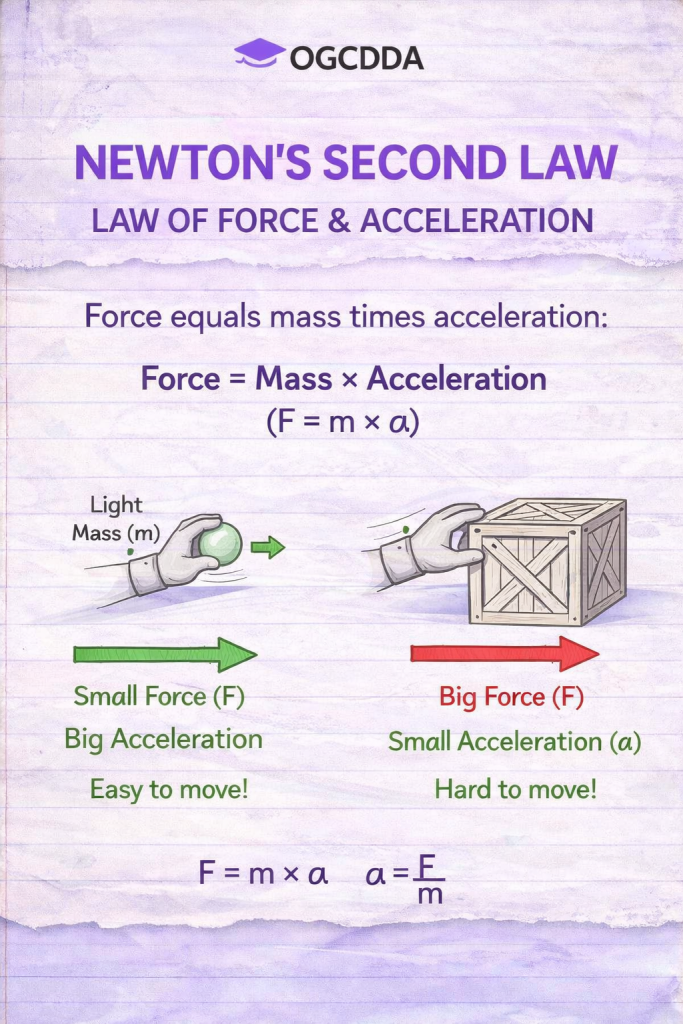
F = ma
Where: F = force m = mass a = acceleration
This equation is fundamental to solving numerical problems in mechanics.
Meaning of F = ma
The equation F = ma shows that acceleration produced in a body is directly proportional to the applied force and inversely proportional to its mass.
For the same force, a lighter object accelerates more than a heavier object. For the same mass, a greater force produces greater acceleration.
In exams, incorrect conclusions often arise when mass is ignored while comparing accelerations.
Unit of Force from Second Law
From F = ma, the SI unit of force is derived.
One newton is defined as the force required to produce an acceleration of 1 m/s² in a body of mass 1 kg.
This definition directly comes from Newton’s Second Law.
Numerical Example
A force of 10 N acts on a body of mass 2 kg. Find the acceleration.
a = F / m = 10 / 2 = 5 m/s²
This type of one-step numerical is common in objective exams.
Newton’s Third Law of Motion
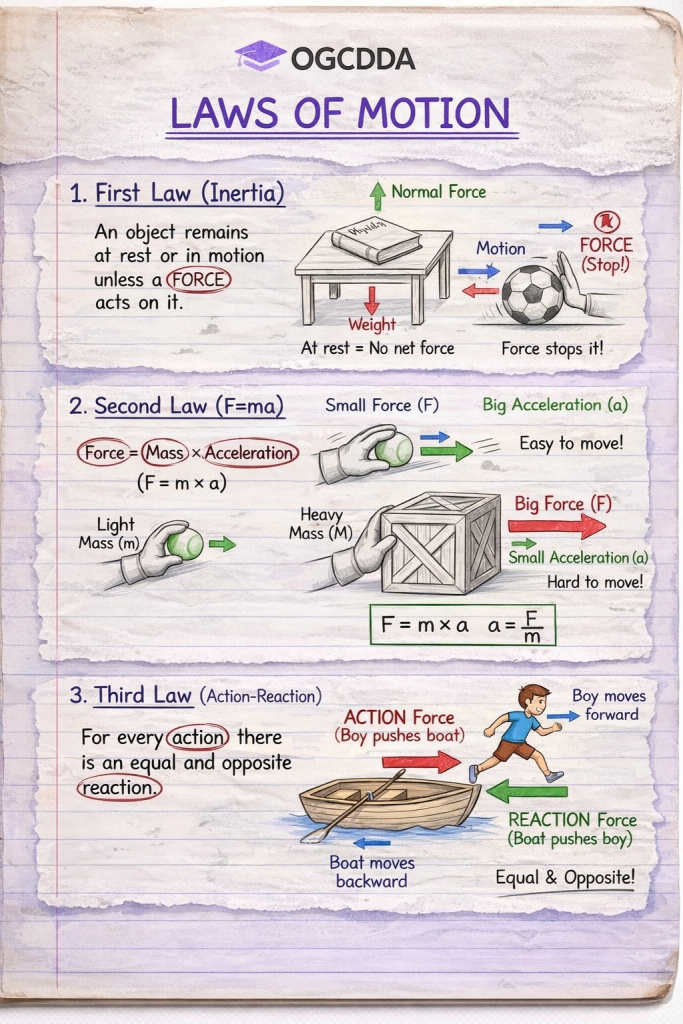
Newton’s Third Law of Motion states that for every action, there is an equal and opposite reaction.
This means that forces always occur in pairs. When one object exerts a force on another, the second object simultaneously exerts a force of equal magnitude but opposite direction on the first object.
Action and reaction forces act on different bodies, not on the same body.
Action and Reaction Forces
Action and reaction forces are equal in magnitude and opposite in direction, but they act on different objects.
For example, when a person pushes a wall, the wall pushes the person back with equal force.
In exams, action and reaction forces should never be cancelled because they do not act on the same body.
Applications of Third Law
Walking is possible because we push the ground backward, and the ground pushes us forward.
Swimming is possible because the swimmer pushes water backward, and water pushes the swimmer forward.
Recoil of a gun occurs because the bullet is pushed forward, and the gun is pushed backward.
Common Misconceptions About Third Law
Action and reaction do not cancel each other.
Action and reaction forces do not act on the same object.
Action and reaction forces always act simultaneously.
Newton’s Laws and Equilibrium
If the net force on a body is zero, the body is in equilibrium.
Equilibrium may mean the body is at rest or moving with constant velocity.
Balanced forces result in equilibrium.
Role of Friction in Laws of Motion
Friction is an external force that opposes motion.
Without friction, objects once set in motion would continue moving indefinitely.
Many real-life situations involve friction, which modifies the motion predicted by Newton’s laws.
Applicability of Newton’s Laws
Newton’s Laws are valid for objects moving at speeds much less than the speed of light.
They are not applicable at atomic scales or relativistic speeds.
FAQs – Laws of Motion
Which law is called the law of inertia?
Newton’s First Law, because it explains the tendency of a body to resist any change in its state of rest or uniform motion.
Does force maintain motion according to Newton’s laws?
No. Force is required only to change motion; uniform motion continues without force when net external force is zero.
What physical quantity actually changes due to force?
Force changes momentum, which may involve change in speed, direction, or both.
Is inertia related to mass or speed?
Inertia depends only on mass, not on speed, force, or shape of the object.
When does Newton’s Second Law reduce to F = ma?
When the mass of the body remains constant during motion.
Are action and reaction forces always equal?
Yes. They are always equal in magnitude and opposite in direction, without any exception.
Why do action and reaction forces not cancel each other?
Because they act on different bodies, not on the same body.
What does zero net force imply about motion?
The body remains at rest or moves with constant velocity in a straight line.
Is friction an external force in Newton’s laws?
Yes. Friction is an external force that alters motion predicted by ideal conditions.
Are Newton’s laws valid at very high speeds or atomic scale?
No. They are valid only for macroscopic objects at ordinary speeds.
Last Moment Notes (Cheat Sheet) – Laws of Motion
- Newton’s First Law states that a body remains at rest or in uniform straight-line motion only when net external force is zero.
- The First Law introduces inertia, which is the resistance to change in motion and depends only on mass, not on speed or force.
- Inertia has three forms: rest, motion, and direction, all representing resistance to different types of change in motion.
- Force is not required to maintain motion; it is required only to change velocity in magnitude or direction.
- Newton’s Second Law states that force equals rate of change of momentum, not velocity directly.
- Momentum is a vector quantity given by p = mv, so any change in speed or direction changes momentum.
- For constant mass, Newton’s Second Law reduces to F = ma, which is used in all basic numericals.
- For the same force, greater mass produces smaller acceleration, and for the same mass, greater force produces greater acceleration.
- The SI unit of force (newton) is derived from the Second Law and equals kg·m/s².
- Newton’s Third Law states that forces always occur in pairs that are equal in magnitude and opposite in direction.
- Action and reaction forces act on different bodies, so they never cancel each other.
- Action–reaction pairs are always simultaneous and belong to the same interaction, not to the same object.
- Recoil of a gun, walking, swimming, and jumping are all direct applications of the Third Law.
- Zero net force implies equilibrium, which may mean rest or uniform motion, not necessarily rest.
- Balanced forces do not change motion but can change shape of a body.
- Unbalanced forces always produce acceleration as per the Second Law.
- Friction is an external force that modifies motion predicted by Newton’s laws in real situations.
- Newton’s laws are valid only for macroscopic objects at ordinary speeds, not at relativistic or atomic scales.
- Statements claiming Newton’s laws work at speeds near light are incorrect in exams.
- If no external force acts, momentum of a system remains constant.
- Any MCQ stating “action and reaction cancel each other” is always wrong.