
Force is defined as a push or a pull that can change the state of rest or motion of an object, or change its shape. This definition focuses on the observable effects of force rather than its internal nature. Since force itself cannot be seen, its presence is always inferred from the changes it produces in an object.
Force always arises due to interaction between two objects. An isolated object cannot exert a force on its own without interacting with another object. Whenever one object exerts a force on another, the second object also exerts a force on the first object, even if the effect is not easily noticeable.
This interaction-based nature of force is very important in exams because it helps eliminate incorrect options that suggest force acting without any interaction. Every force situation must involve at least two interacting bodies.
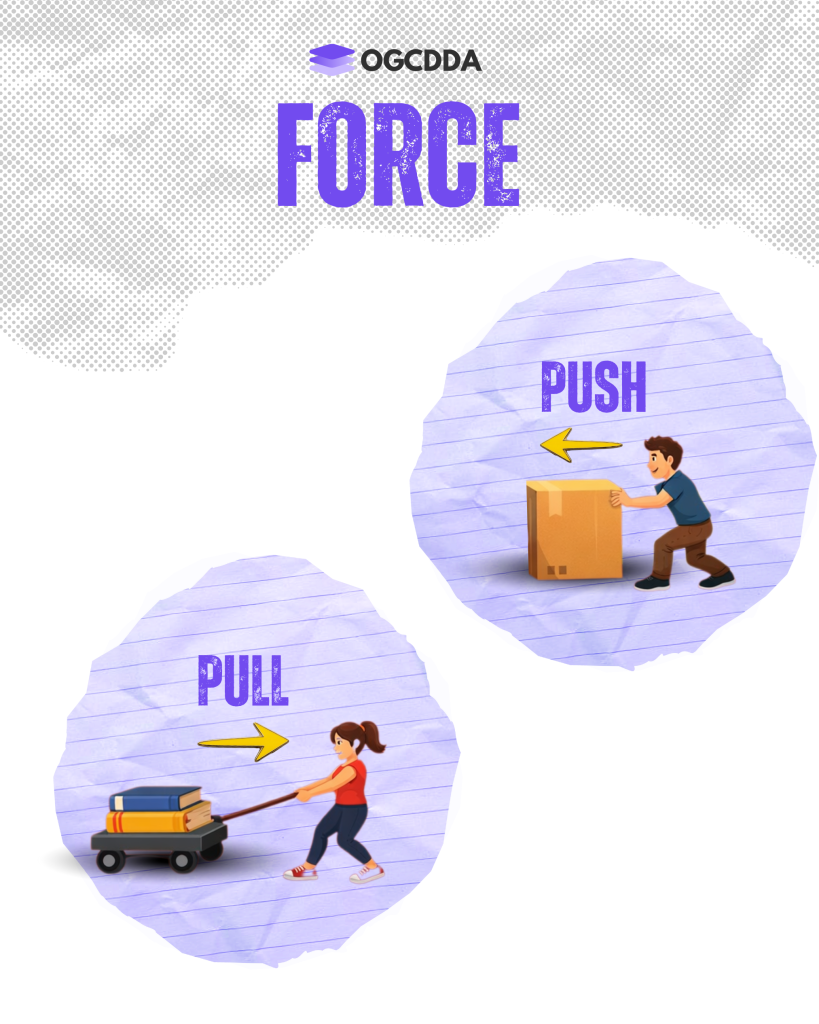
Table of Contents
Effects of Force
A force can change the state of rest of an object by setting a stationary object into motion. When a football lying on the ground is kicked, it starts moving because a force has been applied to it. This shows that force can initiate motion in an object that was previously at rest.
A force can change the state of motion of an object by stopping it or changing its speed. When brakes are applied to a moving bicycle, the bicycle slows down and eventually stops due to the frictional force acting opposite to the direction of motion. This demonstrates that force can reduce speed or bring a moving object to rest.
A force can change the direction of motion of an object without necessarily changing its speed. For example, when a stone tied to a string is rotated in a circular path, the speed of the stone may remain constant, but its direction keeps changing continuously. This change in direction occurs due to the force exerted by the string.
A force can also change the shape or size of an object. Stretching a rubber band, compressing a spring, or squeezing a sponge causes a change in shape due to the applied force. This effect can occur even when there is no visible motion.
Force as a Vector Quantity
Force is a vector quantity, which means it has both magnitude and direction. The magnitude of force indicates how strong the force is, while the direction tells us the way in which the force acts. Both these aspects are equally important in determining the effect of a force.
Two forces of the same magnitude can produce different effects if they act in different directions. For instance, pushing a door near its hinge produces very little rotation, whereas pushing the same door at its outer edge produces significant rotation, even if the applied force is the same.
In numerical problems as well as conceptual MCQs, ignoring the direction of force often leads to incorrect answers. Therefore, force must always be treated as a vector and not as a scalar quantity.
Net Force
When more than one force acts on an object at the same time, the combined effect of all these forces is called the net force or resultant force. Net force is obtained by vector addition of all the forces acting on the object.
If multiple forces act in the same direction, their magnitudes add up to give a larger net force. If forces act in opposite directions, the net force is equal to the difference between their magnitudes and acts in the direction of the larger force.
The motion of an object depends entirely on the net force acting on it and not on individual forces separately. This concept is crucial for understanding why some objects remain at rest even when several forces are acting on them.
Balanced Forces
Forces acting on an object are said to be balanced when their net force is zero. Balanced forces do not change the state of rest or uniform motion of an object. An object under balanced forces either remains at rest or continues moving with constant velocity.
Although balanced forces do not change motion, they can change the shape or size of an object. For example, when equal forces are applied on both ends of a spring, the spring stretches without moving from its position.
A common misconception is that balanced forces mean no forces are acting on the object. In reality, forces are present but their effects cancel each other, resulting in zero net force.
Unbalanced Forces
Forces acting on an object are said to be unbalanced when their net force is not zero. Unbalanced forces always cause a change in the state of rest or motion of an object.
An unbalanced force produces acceleration in the object. Acceleration may involve an increase in speed, decrease in speed, change in direction, or a combination of these changes.
For example, a moving ball gradually slows down and stops due to the unbalanced force of friction acting opposite to its direction of motion. This change in motion clearly indicates the presence of an unbalanced force.
Contact Forces
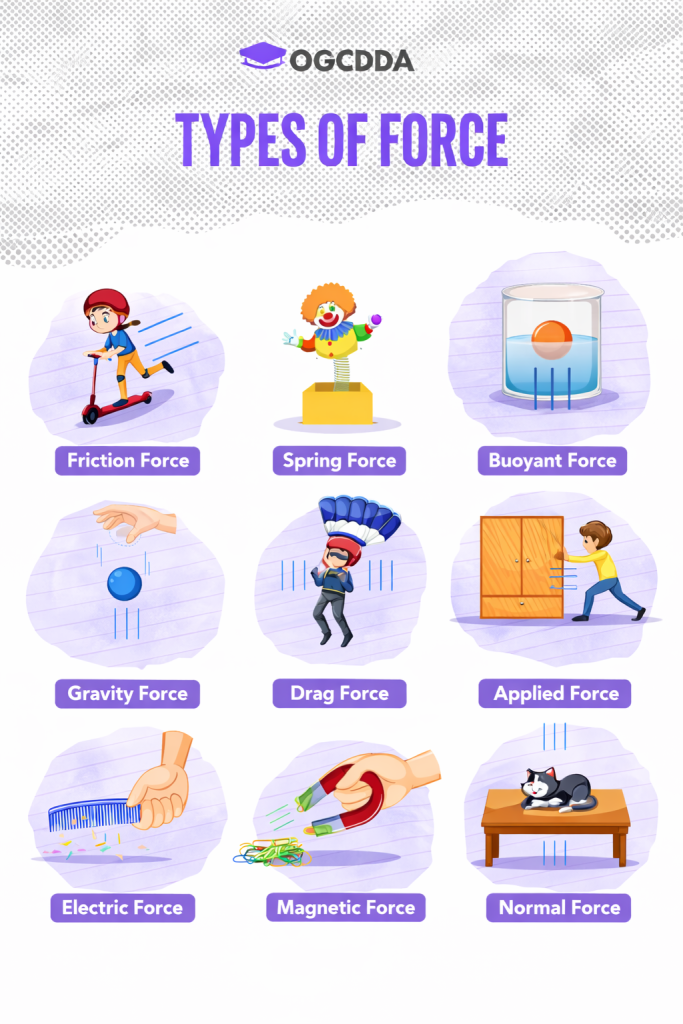
Contact forces are forces that act only when two objects are in physical contact with each other. If the objects are not touching, contact forces cannot act.
Muscular Force
Muscular force is the force applied by the muscles of humans or animals. It is a contact force because physical contact between the source of force and the object is necessary.
Examples of muscular force include lifting a bucket of water, pushing a cart, pulling a rope, kicking a football, and opening or closing a door. In all these cases, the force is applied directly using muscular strength.
In exams, any force applied by humans or animals using their body is classified as muscular force, provided direct contact is involved.
Frictional Force
Friction is the force that opposes the relative motion between two surfaces in contact. It always acts in a direction opposite to the direction of motion or attempted motion.
Friction is essential for activities like walking, writing, and driving because it provides grip. At the same time, friction causes wear and tear and leads to loss of energy in the form of heat.
In objective questions, friction is always identified by two key features: physical contact between surfaces and opposition to motion.
Normal Reaction Force
Normal reaction force is the force exerted by a surface on an object in contact with it, acting perpendicular to the surface. This force prevents objects from passing through solid surfaces.
When a book rests on a table, the table exerts an upward normal reaction force that balances the downward gravitational force on the book. As a result, the book remains at rest.
In exams, whenever an object is resting on a surface without sinking, the presence of normal reaction force should be inferred.
Tension Force
Tension is the force transmitted through a stretched string, rope, cable, or wire. It acts along the length of the string and pulls the objects attached to it.
Examples include a bucket hanging from a rope in a well, a lamp suspended from the ceiling, and a tug-of-war game. In all these cases, the string or rope is under tension.
In MCQs, tension is always considered a contact force and acts away from the object along the string.
Air Resistance
Air resistance is the frictional force exerted by air on a moving object. It opposes the motion of the object through air.
Examples include a parachute slowing down a skydiver, a falling leaf drifting slowly to the ground, and resistance experienced by a moving vehicle. Air resistance increases with speed and surface area.
In exams, air resistance is treated as a type of frictional force and hence as a contact force.
Non-Contact Forces
Non-contact forces are forces that act without physical contact between objects. These forces act from a distance.
Gravitational Force
Gravitational force is the force of attraction between any two masses in the universe. It is always attractive in nature and acts along the line joining the centres of the two masses.
The gravitational force of the Earth pulls objects towards its centre, which is why objects fall when dropped. The weight of an object is the gravitational force acting on it due to the Earth.
In exams, weight is always treated as a force and specifically as gravitational force.
Magnetic Force
Magnetic force is exerted by a magnet on magnetic materials such as iron, cobalt, and nickel, as well as on other magnets. This force can be attractive or repulsive.
Examples include iron filings sticking to a magnet, a compass needle aligning itself with Earth’s magnetic field, and repulsion between like poles of two magnets.
Magnetic force acts without contact and is therefore classified as a non-contact force.
Electrostatic Force
Electrostatic force is the force between electrically charged objects. Like charges repel each other, while unlike charges attract each other.
Examples include a rubbed plastic comb attracting small pieces of paper, a balloon sticking to a wall after rubbing, and lightning during thunderstorms.
Electrostatic force acts from a distance and plays an important role in atomic and molecular interactions.
Force and Motion
Force is required to change the state of rest or uniform motion of an object. If no external force acts on an object, it continues in its existing state of rest or moves with constant velocity in a straight line.
This idea forms the basis of Newton’s First Law of Motion. A common exam trap is the belief that force is required to keep an object moving.
In reality, force is required only to change motion, not to maintain uniform motion.
Force and Acceleration
Force produces acceleration in an object. Acceleration is defined as the rate of change of velocity with time.
Velocity can change due to change in speed, change in direction, or both. Therefore, force can cause speeding up, slowing down, or turning of an object.
This relationship between force and acceleration is fundamental to understanding the laws of motion.
Force and Change in Shape
Forces can deform objects by stretching, compressing, bending, or twisting them. Shape change does not necessarily imply motion.
Balanced forces are sufficient to change shape without changing the state of motion. This distinction is important for eliminating incorrect options in MCQs.
Examples like squeezing a sponge or stretching a spring highlight this effect clearly.
Units of Force
The SI unit of force is the newton (N). One newton is defined as the force required to produce an acceleration of 1 m/s² in a body of mass 1 kg.
Force is measured using instruments such as spring balances, which work on the principle that extension of a spring is proportional to the applied force.
Boundary Conditions
Classical definitions of force apply to everyday objects and speeds. At very small scales or at speeds close to the speed of light, classical mechanics becomes inadequate.
For NDA, CDS, AFCAT, and CAPF examinations, only classical force concepts are required and tested.
PYQs
FAQs
Can force act without contact?
Yes, gravitational, magnetic, and electrostatic forces act without contact.
Do balanced forces mean no force is acting?
No, forces act but cancel each other.
Can force change only direction?
Yes, as in circular motion.
Is force required to keep an object moving?
No, force is required only to change motion.
Can force act on a stationary object?
Yes, balanced forces can act.
Is weight a force?
Yes, weight is gravitational force.
Is friction always harmful?
No, friction is often useful.
Can force change shape without motion?
Yes, balanced forces can.
Is magnetic force contact or non-contact?
Non-contact.
Does greater force always produce greater acceleration?
No, mass also affects acceleration.
Last Moment Notes (Cheat Sheet)
- Force is required to change motion, not to maintain uniform motion.
- Force is a push or pull that changes motion or shape through interaction.
- Force always arises due to interaction between two objects.
- Force is a vector quantity with magnitude and direction.
- Net force determines motion, not individual forces.
- Balanced forces have zero net force and do not change motion.
- Balanced forces can change shape without causing motion.
- Unbalanced forces always produce acceleration.
- Contact forces require physical contact between objects.
- Non-contact forces act from a distance without physical contact.