Scroll →
RIMC Exam 2026 - Complete Overview
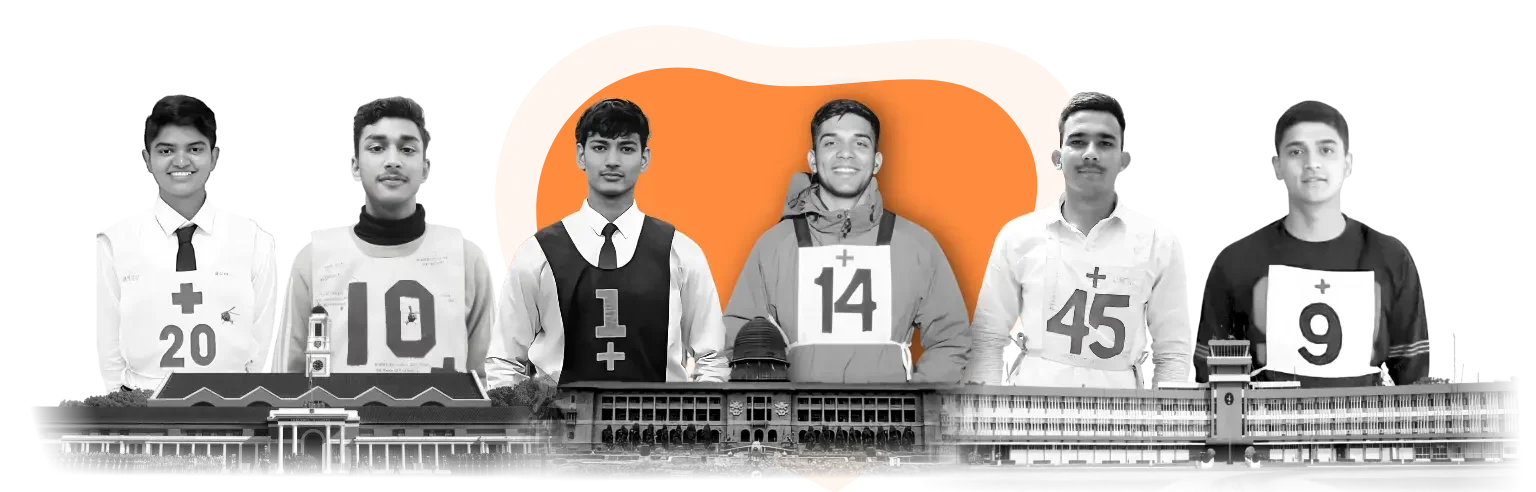
The Rashtriya Indian Military College (RIMC) is a premier residential military school under the Ministry of Defence, Government of India, which prepares young boys for entry into the National Defence Academy by providing academic education along with military training.

Exam Date
Dec, 2026

Free Study Material
Download now >>
What is RIMC Exam?
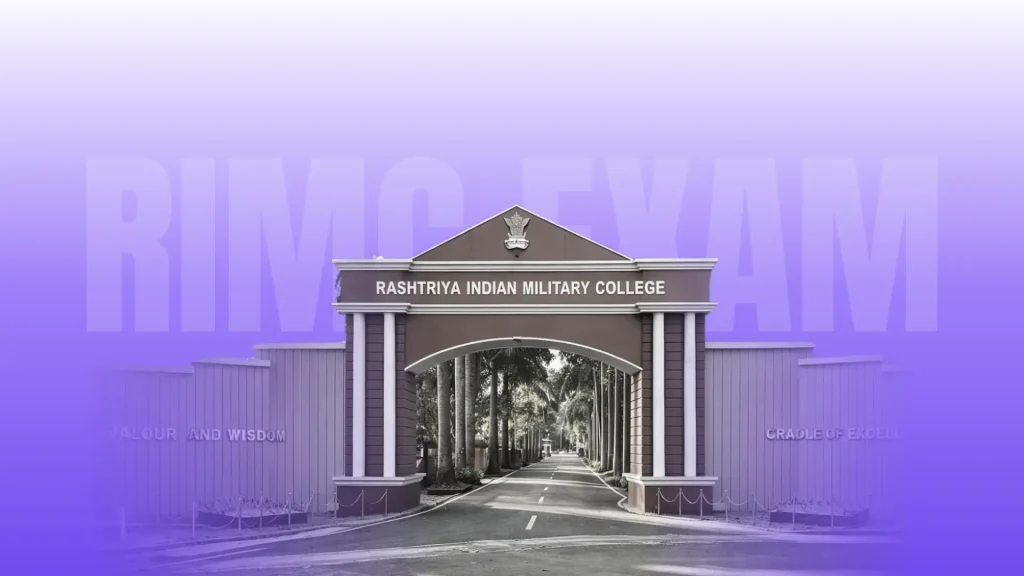
The Rashtriya Indian Military College (RIMC) is a national-level military institution under the Ministry of Defence for boys aspiring to join the armed forces.
It is one of the most prestigious military schools in India, providing academic education and military training to prepare cadets for entry into the National Defence Academy and a disciplined life of leadership and service.
RIMC Latest Updates
- The Notification 2026 has been released for courses commencing in January 2027 at afcat.edcil.co.in.
- The Indian Air Force has opened the AFCAT 1/2026 correction window from December 23 to 24, 2025, until 11:30 PM.
- A total of 340 vacancies have been announced for the post of Flying Branch and Ground Duty (Technical and Non-Technical) Branches.
Free Downloads
- Latest Notifications
- Syllabus
- Eligiblity Criteria
- Previous Year Questions
Free Tools
- Age calculator
- Cut off Calculator
- Medical Fitness Check
- Counselling Sessions
Explore Courses:
It is one of the most prestigious and competitive exams in India.
RIMC Online Course
Target RIMC 2026-27
- 6 - 12 Months
- 1000+ Hours Recorded lectures with top defence exam faculty
- 40+ Online Mocks
- 4000+ Important Questions
RIMC Offline Course
Target RIMC 2026-27
- 6 - 12 Months
- Full syllabus coverage & revision
- Prepare under top defence exam faculty
- Free e-learning platform
Free Counselling
Confused about exam prep? Submit your questions now and get the guidance from the experts
Eligibility Criteria:
Nationality
Criteria
Indian citizens & specified categories only
Nationality Criteria (Detailed)
A candidate applying for the NDA Examination must be one of the following:
- i) a citizen of India, or
- (ii) a subject of Nepal, or
- (iii) a person of Indian origin who has migrated from Pakistan, Burma, Sri Lanka and East African Countries of Kenya, Uganda, the United Republic of Tanzania, Zambia, Malawi, Zaire and Ethiopia or Vietnam with the intention of permanently settling in India.
Provided that a candidate belonging to categories (ii) and (iii), above shall be a person in whose favour a certificate of eligibility has been issued by the Government of India.
Certificate of eligibility will not, however, be necessary in the case of candidates who are Gorkha subjects of Nepal.
Age limit
11½ - 13 years (As per the official notification)
Age Criteria
To be eligible for the AFCAT examination, a candidate must fall within the age limits specified in the official Indian Air Force notification. The age criteria vary depending on the branch applied for.
- Flying Branch: Candidates must be between 20 and 24 years of age at the time of commencement of the course. The upper age limit may be relaxed up to 26 years for candidates holding a valid and current Commercial Pilot Licence issued by the DGCA (India).
- Ground Duty (Technical and Non-Technical) Branches:
Candidates must be between 20 and 26 years of age.
Only candidates born within the prescribed date range mentioned in the official notification are eligible. No age relaxation is permitted beyond the specified criteria, and candidates are advised to carefully verify their date of birth before applying.
Instantly verify eligibility based on your date of birth.
Marital Status (Mandatory Condition)
Candidates must be unmarried at the time of application.
Marriage is not permitted during training at the National Defence Academy.
Educational Qualification
Studying in Class 7 or have passed Class 7
Educational Qualification for NDA Exam
Educational qualification for the AFCAT examination depends on the branch applied for. Candidates must meet the required qualification on or before the date specified in the official Indian Air Force notification.
- Flying Branch
Candidate must hold a Bachelor’s degree in any discipline with a minimum of 60 per cent marks from a recognised university with Physics and Mathematics at the 10+2 level, or a Bachelor of Engineering/Technology (BE/BTech) degree with at least 60 per cent marks. - Ground Duty (Technical) Branch
Candidate must hold a Bachelor’s degree in Engineering/Technology in the relevant discipline with a minimum of 60 per cent marks from a recognised university. - Ground Duty (Non-Technical) Branch
Candidate must hold a Bachelor’s degree in any discipline with a minimum of 60 per cent marks from a recognised university. Specific roles such as Administration, Logistics, Accounts, Education, and Meteorology may have additional subject requirements as mentioned in the official notification.
Candidates in the final year/semester are also eligible to apply, provided they produce proof of passing the qualifying examination within the prescribed timeline.
Instantly check your attempt left for AFCAT exam
Gender & Physical Standards
Male & Female • Must be medically fit as per RIMC medical standards.
Gender & Physical Standards
The AFCAT Examination is open to both male and female candidates.
Candidates must be physically and medically fit according to the standards prescribed by the Armed Forces.
Medical fitness is assessed only after clearing the SSB Interview, and is mandatory for final selection.
- General Medical Requirements Include:
- Minimum height as prescribed for the respective service
- Weight proportionate to height and age
- Normal vision standards as per service norms
- Normal hearing
- No permanent bodily deformities
- No chronic or long-term medical conditions
Pre-check height, weight, and basic medical parameters before SSB medicals.
RIMC Selection Proccess
The selection process for the RIMC examination is conducted in multiple stages, and a candidate must qualify each stage separately to move forward. Final selection is based strictly on merit and medical fitness.
Stage 1: RIMC Written Examination
- Candidates first appear for the RIMC written examination conducted for admission to Rashtriya Indian Military College.
- Selection for the next stage is based on performance in the written exam and the cut-off marks fixed by RIMC.
Important: Only candidates who qualify the written examination are shortlisted for the Viva Voce (Interview) stage.
Stage 2: Viva Voce (Interview)
Conducted by a Board appointed by the Rashtriya Indian Military College (RIMC)
The Viva Voce is the second stage of the RIMC selection process and is conducted for candidates who qualify the written examination.
Features of Viva Voce:
- Oral examination of 50 marks
- Tests intelligence and general awareness
- Assesses confidence and communication skills
- Evaluates personality and leadership traits
- Determines suitability for military training
Stage 3: Medical
Candidates recommended after the Viva Voce undergo a medical examination conducted by authorized military medical boards.
Medical standards are strictly as per RIMC and Armed Forces norms.
Important: Both temporary and permanent medical unfitness can lead to rejection.
There is no relaxation in medical standards.
Stage 4: Final Selection
The final merit list is prepared based on:
- Written examination marks
- Viva Voce (Interview) marks
(Medical fitness is mandatory for inclusion in the merit list.)
Final admission depends on:
- Merit rank
- Availability of vacancies
- State-wise seat allotment norms as laid down by the Rashtriya Indian Military College (RIMC).
Candidates placed in the final merit list receive joining instructions from the Rashtriya Indian Military College (RIMC) and must report to the RIMC campus at Dehradun for admission, subject to medical fitness and availability of vacancies.
RIMC Syllabus
The RIMC written examination syllabus is designed to assess a candidate’s academic foundation, logical thinking, and general awareness up to the Class 7 level, in line with the requirements for admission to Rashtriya Indian Military College.
Part A: English (125 Marks)
- Reading Comprehension
- Unseen Poem
- Essay Writing
- Letter Writing
- Story Writing
- Common Errors
- Synonyms & Antonyms
- One-Word Substitution
- Idioms & Phrases
- Grammar: Noun, Pronoun, Verb, Adjective, Adverb, Preposition, Conjunction
- Transformation of Sentences (Active/Passive, Direct/Indirect Speech)
- Spellings & Vocabulary
Pro Tip: Click on any chapter above to access short, exam-focused notes.
Part C: Mathematics (200 Marks)
- Number System
- HCF & LCM
- Square & Cube Roots
- Average, Ratio & Proportion
- Percentage
- Profit & Loss
- Time, Speed & Distance
- Time & Work
- Simple & Compound Interest
- Basic Operations & Factorization
- Linear Equations
- Set Theory (Basic)
- Lines & Angles
- Triangles, Quadrilaterals & Polygons
- Geometry (basic properties & constructions)
- Mensuration (Area & Volume)
- Data Handling (simple statistics)
Pro Tip: Click on any chapter above to access short, exam-focused notes.
Part A: General Knowledge (75Marks)
General Science
- Motion and laws of motion
- Work, energy, and power
- Heat and thermodynamics
- Sound and waves
- Electricity and magnetism
- Adverb
- Physical and chemical changes
- Elements, compounds, and mixtures
- Acids, bases, and salts
- Metals and non-metals
- Fuels and everyday chemistry
General static GK and Sports
- Physical and chemical changes
Economy & Social developments
- Human body and nutrition
- Diseases and prevention
- Environment and ecology
Indian History
- Ancient, medieval, and modern Indian history
- Indian freedom struggle
- Important historical movements
Indian Geography
- Earth and its structure
- Climate and weather
- Indian geography
- Natural resources
Indian Polity & Constitution
- Indian Constitution
- Fundamental rights and duties
- Structure of government
Current Affairs
- National and international events
- Defence-related developments
- Sports, awards, and important appointments
Pro Tip: Click on any chapter above to access short, exam-focused notes.
RIMC Result
The RIMC cut-off is the minimum score required to qualify for the next stage of the selection process.
Written Exam Cut-Off
This is the minimum score required to qualify the AFCAT written examination.
It is calculated out of 300 marks:
AFCAT Written Exam: 300 marks
Candidates must:
- Secure the overall written cut-off, and
- Obtain the minimum qualifying marks in each paper separately.
Only candidates who clear the written cut-off are issued SSB call-up instructions.
Final Cut-Off
The final cut-off for AFCAT is calculated out of 600 marks:
- Written Examination: 300
AFSB Interview: 300
It determines:
- Final selection
- Merit rank
Branch allocation (Flying, Ground Duty Technical, Ground Duty Non-Technical)
Only candidates who clear the written cut-off are issued SSB call-up instructions.
Free Tools
- Age calculator
- Cut off Calculator
- Medical Fitness Check
- Counselling Sessions
Free Downloads
- Latest Notifications
- Syllabus
- Eligiblity Criteria
- Previous Year Questions